


If you are planning your ad budget for 2027, you are dealing with three things at once: prices that keep climbing, platforms whose AI now does the targeting, and more places to spend than anyone has time to test. This guide covers Google, Meta, and LinkedIn, and how AI-powered ads change what you get to control on each.
We published the first version in May 2020. It gave nine reasons to advertise on Google, said Facebook had over a billion users, and told you to check your ads every day. Almost none of that survives.
You used to pick the audience, write three ads, and set a bid. Now, with AI-powered ads, the platform picks the audience, the placement, and most of the bid. Your job is what it cannot do: choose the platform, define and track the conversion, give it real creative, and decide the most you will pay for a customer.
The short pick: if people already search for what you sell, start with Google. If they do not, start with Meta. If your buyer is a job title, consider LinkedIn.
What Changed?
| 2020 | Now | |
| Targeting | You chose interests, behaviors, and lookalikes | The platform's AI chooses from what your creative shows it |
| Measurement | One pixel on your site | Pixel plus server-side data |
| Your lever | Audience settings | The conversion you define, the creative you supply, the ceiling you set |
Apple's privacy policy change in April 2021 stopped apps from tracking people across other apps unless they opted in, so the pixel could no longer see many of the sales your ads produced. That mattered because so much money rode on that tracking: advertisers spent about $115 billion on Meta ads in 2021 (1), and Meta's CFO put the hit to its own 2022 revenue at about $10 billion (2). That is why Meta's documentation now has you send events from your server as well (the pixel's sidekick), with a shared ID so the same sale is not counted twice: Meta's deduplication guide (3).
When the machine chooses who sees the ad, the ad is the targeting. Think of the platform's AI as a very enthusiastic intern: fast, tireless, and happy to spend your budget on whatever you hand it. A good photo of a real person doing a real thing tells it who to show the ad to better than any interest list you could type.
Which Social Media Platform Should You Advertise On?
In our discovery calls, business leaders often ask which platform they should be on. A better question is what your buyer is doing right now. Choose based on that, then check that the money works:
- Are people already searching for what you sell? Start with Google Search, alone, with tracking.
- Are they not searching yet? That happens with a new category, a cause, or an event, when you are creating demand. Use Meta, or TikTok if your audience is young and you can make video that looks native there. Offer something free or low-friction first, like a guide or a class.
- Is your buyer a job title, such as a CFO, a program officer, or a corporate partner? Consider LinkedIn, but only if the audience is at least 50,000 people and one customer is worth thousands of dollars. That threshold is our own recommendation, not LinkedIn's.
- Do the math (next section), then run one channel and one conversion for 8 to 12 weeks. Add a second only when the first has a cost per customer you can state.
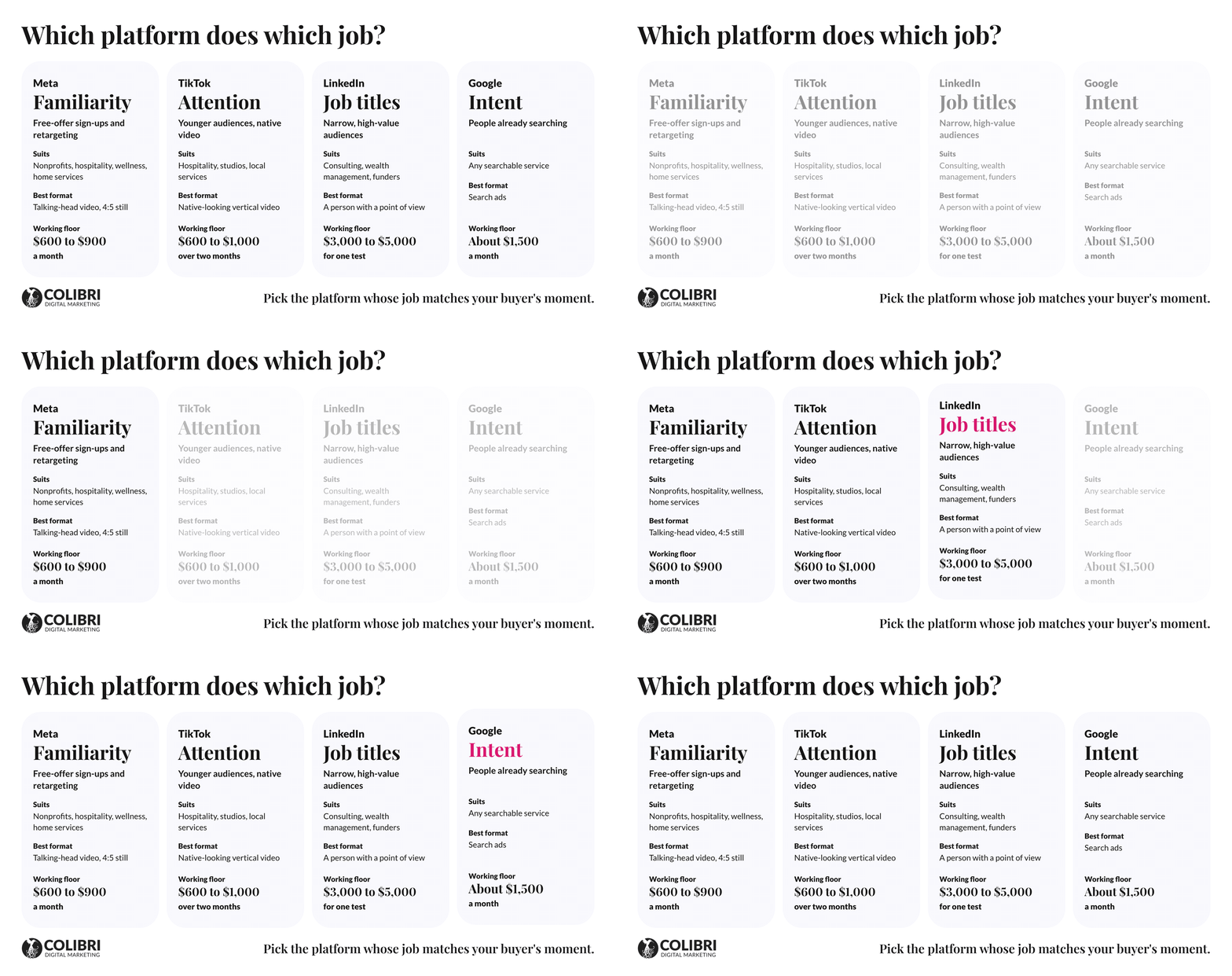
| Platform | What it is for | Suits |
| Meta (Facebook, Instagram) | Building familiarity and free-offer sign-ups; retargeting | Nonprofits with a warm audience, hospitality, health and wellness (with care), home services |
| TikTok | Attention from younger audiences with video | Hospitality, studios, local services with visual proof |
| Reaching a job function or seniority | Consulting, wealth management, funders and partners | |
| Capturing existing intent | Almost everyone with a searchable service |
Pinterest belongs on the list for weddings, events, and home projects, as a later test. Pick the platform whose job matches your buyer's moment.
How Much Will Social Media Advertising Cost Going into 2027?
Start with your own ceiling, because every published benchmark averages other people's businesses.
The formula, with illustrative numbers (not a benchmark):
- Cost per click, say $5, divided by the share of visitors who convert on your page, say 4%, gives a cost per lead of $125.
- Cost per lead divided by the share of leads who become customers, say 20%, gives a cost per customer of $625.
- Compare that to the profit (not the revenue) one customer brings you inside your payback window.
A spreadsheet runs this sum in a minute, and so does any AI assistant if you paste your numbers in. If a new client is worth $3,000 in first-year gross profit, $625 is fine. If a client is worth $300, you are paying $625 to win $300. The channel cannot pay for itself, and more budget will not fix it. Fix the price, the offer, or the webpage first. Nonprofits can run the same sum with the value they assign to a donor, a volunteer, or an event seat.
Now the ranges, with each sample's date in the last column. The sources disagree, so treat them as planning numbers for 2027.
| Platform | What the sources say | Sample and date |
| Meta, lead and traffic campaigns | Median $1.92 per click and $27.66 per lead (4); traffic campaigns $0.70 per click (4) | 554 traffic and 726 lead campaigns, US, April 2024 to June 2025 |
| Meta, health and fitness | $52.98 per lead (4) | Same sample |
| Google Search | Median $70.11 per lead (5), up 5% on the year before | 16,446 US campaigns, April 2024 to March 2025 |
| No benchmark we trust; see below | Planning floors in the next table |
Meta's average price per ad rose 12% year over year in Q2 2026 (6), so read the Meta rows as a floor. Costs usually rise again in Q4, which matters if you are planning around Black Friday.
LinkedIn is where benchmarks help least. Vendor roundups disagree so widely on cost per click that the size and narrowness of your own audience decides what you pay. Plan from LinkedIn's own numbers (7): to A/B test an AI-built Accelerate campaign against a standard one, LinkedIn requires at least 14 days and a lifetime budget of $700 per campaign for website visits or $3,000 for lead generation, so $1,400 or $6,000 for the control and test pair. For the full B2B treatment, see our LinkedIn Ads strategy guide.
How Much Should You Spend to Test?
Enough to learn something. Five dollars a day split across four campaigns never leaves the learning phase. These floors come from the math above and from what we see in accounts, not from platform rules:
| Platform | Working floor | How long to hold |
| Meta | $20 to $30 a day on one prospecting campaign (about $600 to $900 a month) plus a small retargeting pool | 4 to 6 weeks before judging the creative |
| TikTok | About $600 to $1,000 for a two-month trial | Written as an experiment with a stop rule |
| $3,000 to $5,000 for one lead generation test campaign, or do not run it. A formal A/B pair is $6,000 or more | 6 to 8 weeks (LinkedIn's A/B minimum is 14 days) | |
| Google Search | About $1,500 a month for lead generation at a $4 to $6 click | Judge tracking at week 4, cost per customer at week 8 |
For a small organization, run one LinkedIn campaign and judge it on cost per lead. Launch a second one only once it has earned the second $3,000.
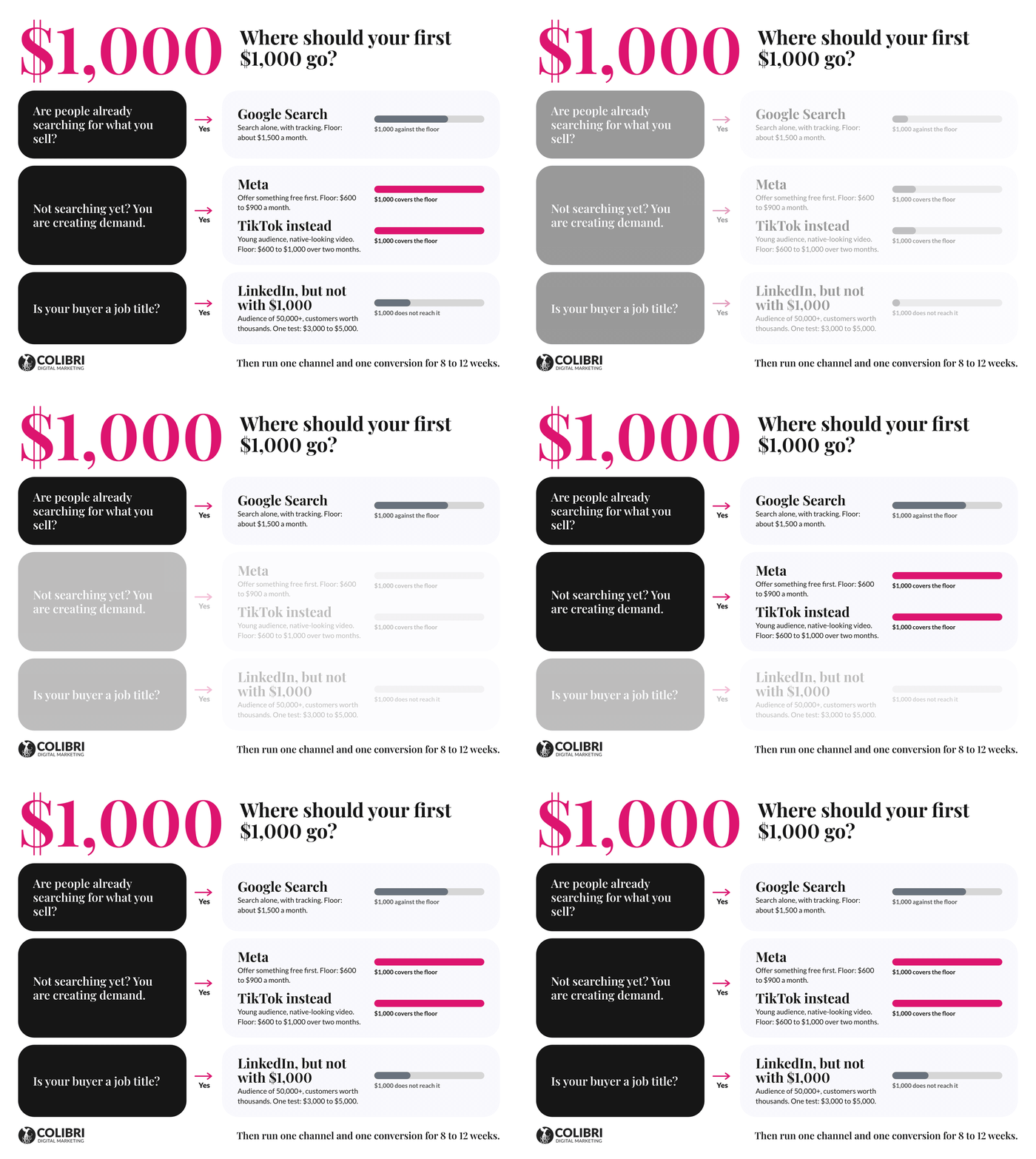
Write the stop rule before launch, while you are still objective. Our recommendation is two months at most, or one month if nothing comes in. Before you blame the ad, channel your inner Dr. House: if traffic arrives and nobody converts, the page is the first suspect in our diagnosis.
Where Do Google Ads Fit Next to Social?
Google captures demand that already exists. Social creates it. That is the whole difference, and it is why we recommend most brands synchronize their efforts.
Think of it as a sequence. Start with Search because it captures people already looking for what you sell and shows you what a conversion costs. Once you understand that number, add Performance Max to scale it. Demand Gen works more like social: it puts your ads in front of people on YouTube and Discover before they search.
Which Ad Format Works on Each Platform?
The format that works looks like a post made by a person. On Meta and TikTok, that means a short vertical video of someone speaking to camera, in a real place, with captions. On LinkedIn, it means a person with a point of view. What gets scrolled past is the stock photo of a handshake with the headline swapped four times.
Our working rule for a small budget: three or four clearly different concepts, each in two formats (one 9:16 video, one 4:5 still). A concept is a different person, setting, promise, or hook. A new headline on the same photo is one ad, not two. It is how we shrink the variety-over-audience-tweaking advice to a small team's size (8).
Shoot once a quarter, framed for every ratio at once, so one shoot feeds Meta, Google, and LinkedIn. Name files by platform, concept, format, and version.
In a small, local audience, creative fatigue is a certainty. Refresh visuals when frequency climbs past two or three a month, usually every 6 to 8 weeks, before the leads drop.
Can AI Make Your Ads?
For resizing, background fixes, text variants, and translations, yes. The platforms all push these tools, and they save real hours.
Three limits:
- Keep AI on the variants and off the face of your brand. If every competitor uses the same tool, the output converges.
- Never put a synthetic person in as a beneficiary, a donor, or a client. For a mission-driven organization, trust is the asset.
- Never fake the proof. The FTC's 2024 rule bans fake reviews and testimonials, including those from people who don't exist, and imposes civil penalties for knowing violators (9).
A simple test: would you be comfortable if a donor or client watched the making-of? If not, don't run it.
Boost a Post or Build the Campaign?
Often the best ad is a post that already earned its place. Post organically for two to four weeks, then judge by sends, saves, and reach to non-followers, not likes. Boost to test whether a post has legs. Move to Ads Manager for a specific goal, such as sign-ups or donations, or for clean numbers.
A small example from our work: a home furniture retailer in Oregon put $450 a month into boosted posts built on carousels and short videos, and reached a 3.8% click-through rate against a 0.7% benchmark. See? A small budget can work when the creative earns the click.
Partnership ads, where a creator or partner posts and you run their post as an ad, are worth a test. For a nonprofit, that can be a volunteer, a board member, or a partner organization. Get permission in writing, and label paid or perk-based posts as partnerships.
Give every campaign a comment owner. Hide spam and scams, answer questions and honest criticism within a day, and never mass-hide.
How to Launch Your First Social Ad Campaign
Here are the five steps:
- Define one conversion, the action that makes you money, and give it a value even if it is an estimate.
- Track it with the pixel and server-side events, deduplicated, and test with a sample conversion. If you need a little help, start with our Google Analytics guide.
- Match it to your records. We recommend that platform conversions land within about 10% of your CRM or booking tool. A birth center we worked with tracked ads through to bookings and found that by March 2023, 44.83% of its 87 bookings came directly from ads, on an average monthly spend of about $1,500.
- Build a page for that one action, with one ask that matches the ad's promise.
- Pick one platform and 3 to 4 concepts, set the budget floor and the stop rule, then leave it alone for the learning period. Change budgets slowly, with decreases of 20% or less.
When we set up an account at Colibri, we test the conversion before the first dollar goes out. On most new accounts, the first thing we fix is a broken event.
What Should You Watch in the First Eight Weeks?
Weekly, not daily (yes, we told you the opposite in 2020). Touching bids, budgets, and settings every day resets the system's learning. Here is the check, week by week:
- Week one: Is the conversion firing, and does it match your records?
- Weeks two to four: Which concepts reach new people?
- Week eight: Judge cost per customer. A cheap click is not a cheap customer.
Which Mistakes Cost the Most?
These seven do, and we see most of them in the accounts we review:
- No conversion defined, or the wrong one. Page views and button taps teach the AI to find cheap junk.
- Pixel only. No server-side events, no shared ID, so Meta sees a fraction of what happened.
- Trusting the platform's own report. Check analytics and your CRM. Platforms grade their own homework (and tend to give themselves an A).
- Sending paid traffic to the homepage. Give the ad a page of its own.
- Underfunding, then judging. Fewer campaigns, bigger budgets, four weeks or more.
- Never refreshing your creative, so the same ads wear out.
- Using the wrong platform for the job, like judging Meta on paid sign-ups, which it wasn't built for.
If You're a Nonprofit, in Health, or in Finance
Nonprofits
- Google Ad Grants return less than most people assume. In M+R's 2026 benchmarks, search returned $2.48 per $1 spent, against $0.17 for Google Ad Grants, and Meta cost $3.64 per lead (all 2025 data) (10).
- Read Ad Grants as cheap reach and list growth, not a fundraising engine. It has rules: a minimum 5% click-through rate each month, and two months in a row below it means temporary deactivation.
- If your ad is about a social issue, Meta requires you to complete its authorization process and add a verified "Paid for by" disclaimer first, so plan extra time.
Health and Wellness
- Google treats health as a sensitive category: no Customer Match or lookalike-style personalization.
- On Meta, a website placed in a restricted data category can lose some mid- and lower-funnel events. Meta's page does not name health, so check your data source's category in Events Manager, and consider optimizing on an earlier step.
Financial Services and Wealth Management
- Meta's Financial Products and Services special ad category removes age and gender targeting and sets a 15-mile minimum radius.
- Google applies similar limits to consumer credit ads.
- Advisers also face the SEC's Marketing Rule, whose staff FAQ was updated in January 2026.
Housing, employment, and credit ads carry the same targeting limits on Google in the US and Canada, and on Meta. Declare the category at setup.
What's New as You Plan for 2027?
Meta and TikTok both announced AI agents in October 2026. Meta says building campaigns and changing budgets by conversation is coming soon. TikTok announced conversational lead capture and a wider Smart+, with no availability dates. Wait for dates before you plan around either.
When Should You Not Run Social Ads Yet?
Hold off if any of these is true:
- You cannot track a conversion. The platform will optimize for noise.
- One customer's profit is smaller than your cost per customer. Ads will only show you the leak faster.
- You have no page built for the action, or nothing real to show in the creative.
Each one is cheaper to fix before you spend than after.
Pick One Platform and One Conversion
Choose the platform by what your buyer is doing, define the one action that earns you money, and decide what you will pay for a customer before the platform's AI decides for you.
If you'd like to talk it through, schedule a complimentary call with our team.